

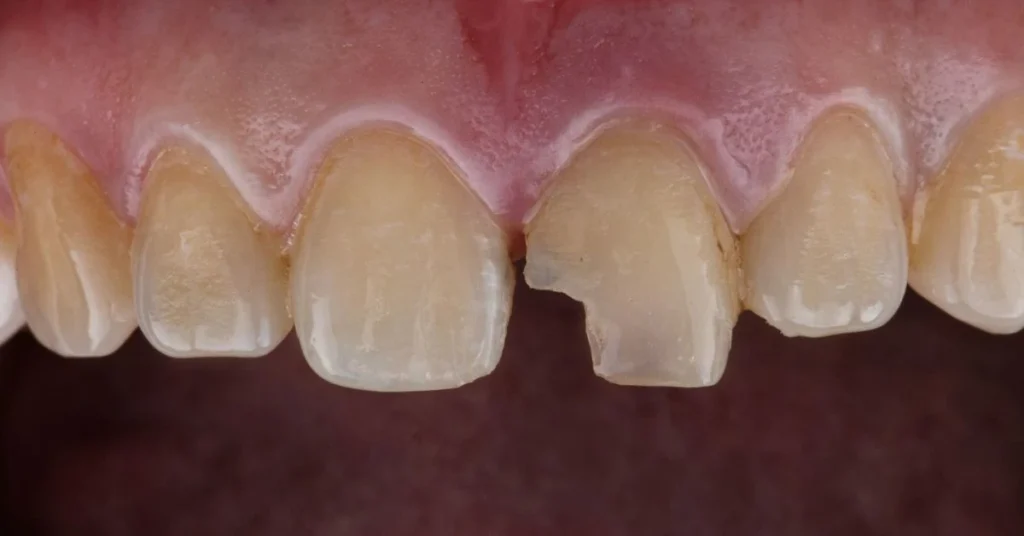
You bite down on something hard and hear a little crack. Then your tongue finds a sharp edge that wasn’t there a minute ago. Chipped teeth are common, and most of them can be repaired. This page covers what to do first, how we restore a chipped tooth, and which chips shouldn’t wait.
What counts as a chipped tooth
Enamel is the outer layer of your tooth, and it’s the hardest material in your body. It still breaks. When a piece comes off, that’s a chip.
Some chips are barely noticeable, just a rough patch you keep touching with your tongue. Deeper ones expose the dentin underneath, and some reach the nerve. Once that happens you’ll usually feel it when you drink something hot or cold.
People often mix up chips and cracks. A chip takes a piece off the surface. A crack runs into the tooth, and it can travel below the gumline. The mirror won’t tell you which one you have. We need an exam and an X-ray for that.
Why teeth chip
Most of the time it’s something ordinary: ice, hard candy, popcorn kernels, a bone in your dinner. Falls and sports injuries do it too, and so does grinding your teeth in your sleep. Plenty of people chip a tooth opening a package with their teeth. Teeth with big old fillings or cavities are weaker to begin with, and so are teeth with enamel worn thin by acidic food and drinks or acid reflux.
If a tooth chipped on something soft, like bread or pasta, it was probably already weak.
What to do right away
Rinse with warm water. Look for the broken piece, and if you find it, put it in milk and bring it in. If the edge is sharp, cover it with dental wax or a bit of sugar-free gum so it doesn’t cut your cheek or tongue.
Eat soft foods for now and chew on the other side. If it aches, an ice pack helps, and so does an over-the-counter pain reliever taken as the label directs.
Then call. A chipped tooth doesn’t heal itself, and a tooth that feels fine today can still be exposed to bacteria. It’s better to have it looked at than to wait and see.
How we restore a chipped tooth
What we do depends on how much tooth is missing, where the chip is, and how your teeth meet when you bite.
- Polishing. If the chip is tiny, we may only smooth the edge until it feels normal.
- Bonding. This is the usual choice for front teeth. We add tooth-colored resin to the chipped area, shape it to match the tooth, and harden it with a curing light. It’s quick and usually finished in one visit.
- Fillings. Back teeth, or chips near a cavity or an old filling, often need a filling to rebuild the tooth so you can chew properly.
- Veneers. These make sense when a front tooth is chipped and you’d also like to change its shape or color. A veneer is a thin porcelain shell.
- Crowns. If a large part of the tooth is gone, a crown goes over the whole thing and keeps it from breaking again.
- Root canal. When the chip has reached the nerve and the tooth is infected or hurts constantly, a root canal may be needed. A crown normally follows.
- Extraction and replacement. Once in a while a tooth can’t be saved. Then we’d talk about replacing it, and an implant is one of the options.
We will show you your X-ray and explain what’s going on. The decision is yours.
Can it be done in one visit?
Often it can. Many chipped tooth restorations are finished the same day, depending on the repair. We use digital scans and imaging to plan the work, so there’s less guessing and usually fewer appointments.
Some teeth take longer. A crown might need to be made, or the tooth might need other treatment first. We’ll tell you before we start.
When a chipped tooth is an emergency
If it’s a small chip and doesn’t hurt, a few days’ wait is usually fine. Call us right away if you have:
- Pain that doesn’t go away, or sensitivity to hot, cold or pressure
- Swelling or bleeding around the tooth
- A big missing piece, or a tooth that looks cracked
- A chip from an injury to your face
Our emergency exam is $79 for patients without insurance, and it includes an X-ray of the problem tooth. If you call before noon, we’ll try to see you that day.
Preventing chipped teeth
You can’t stop every chip, but a few habits help. Wear a mouthguard for contact sports. If you grind your teeth at night, ask us about a nightguard. Stop chewing ice, and keep scissors handy so you’re not using your teeth. Get cavities treated early, because decayed teeth break more easily. And keep up your regular exams, since we can often spot a weak tooth before it gives out.
Cost and insurance
The price depends on the repair. We go over your options and expected costs before we begin. We accept most major PPO plans and can help you sort out your benefits. If you don’t have insurance, ask about our Blueprint Smiles Membership Plan. Financing is available through CareCredit, Sunbit and Cherry.
Frequently asked questions
1. Can a chipped tooth heal on its own?
2. How long does a repair last?
3. Will restoration hurt?
4. Do I need to come in for a small chip that doesn’t hurt?
5. Can you put the broken piece back on?
6. How much does it cost?
Conclusion
A chipped tooth can be upsetting, but chipped tooth restoration is routine dental work, and most repairs are straightforward. Whether you need a quick polish, a bonded repair or a crown, the first step is the same: get it checked. Putting it off rarely helps, and a chip that’s treated early is usually easier to fix.
If you’ve chipped a tooth, call or text Duluth Dental Studio at 770-696-4144, or book online anytime.
We’re also proud to welcome patients from nearby communities who come to us for trusted cosmetic dental care, including:
Every patient gets a personalized plan built around results that look and feel completely natural.
Author Bio
Dr. Maulik Gandhi, earned his dental degree from Indiana University School of Dentistry and provides preventive, restorative, cosmetic, and surgical dental care, including the early diagnosis and treatment of gum disease.
3575 Koger Blvd, Suite 160
Duluth, GA 30096
Phone: 770-696-4144
Email: staff@duluthdentalstudio.com


